

Signs of Hope We Almost Missed
What Persistence Makes Possible
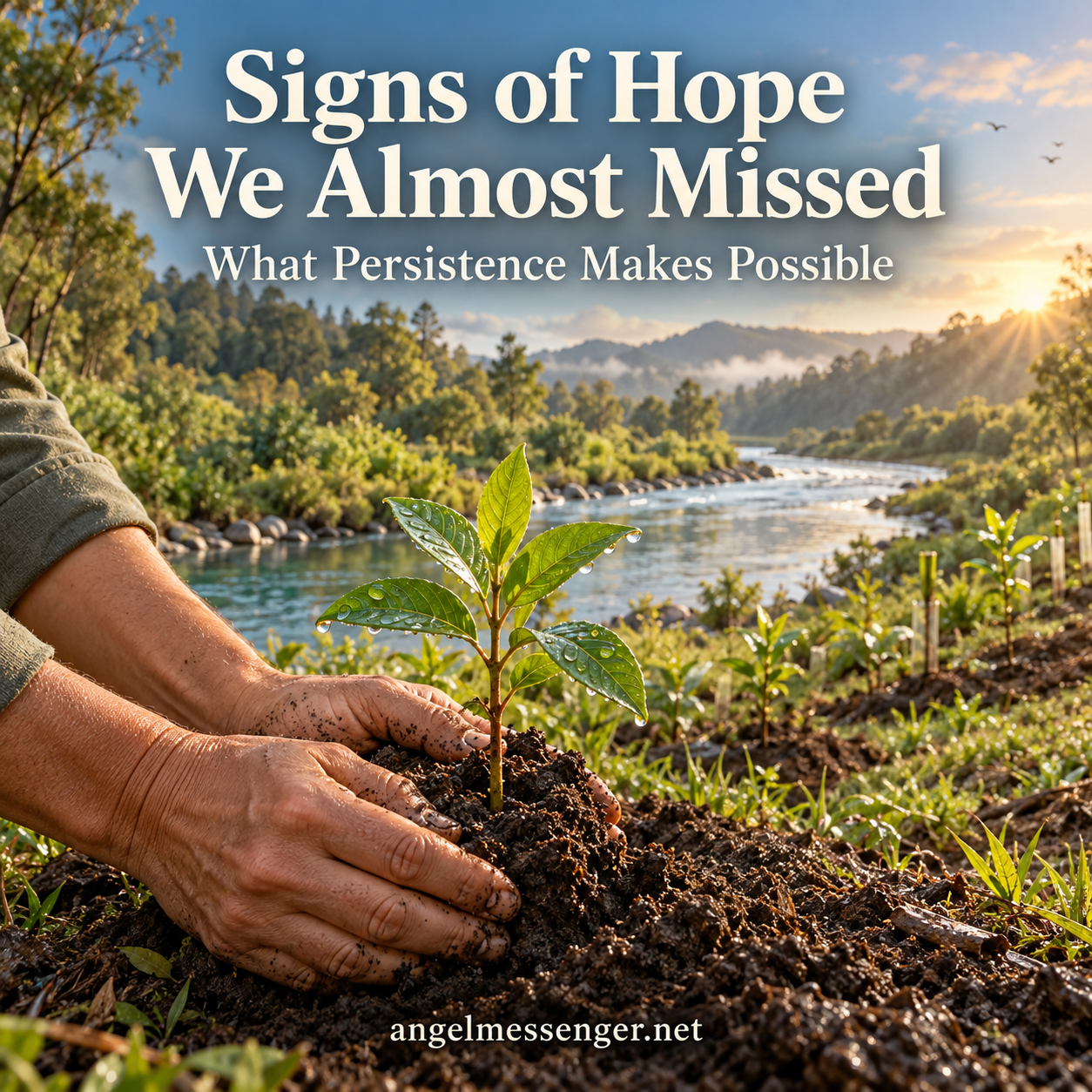
by Rev. Sheri Spiritual teacher, writer, and founder of Angel Messenger
When we hear about something wonderful finally happening, we usually see only the moment of success.
A new treatment is approved.
An endangered species reaches an important milestone.
A creature returns to a place where it had disappeared.
A tiny light shines again after more than a century.
What we do not always see are the years of effort that came before that moment.
The researchers who kept working after experiments failed.
The conservationists who protected animals they were not certain they could save.
The volunteers who gave their time without knowing whether their work would succeed.
The communities that continued restoring damaged places long before there was visible proof that anything was changing.
Some of the most hopeful stories from the past month remind us that meaningful change rarely happens all at once. More often, hope is built through persistence—one careful decision, one protected life and one more attempt at a time.
A New Treatment Offers Hope for Pancreatic Cancer
Pancreatic cancer has long been considered one of the most difficult cancers to treat. It is often discovered after it has already spread, and patients have historically had far too few effective options.
In August, the U.S. Food and Drug Administration approved a new once-daily pill called Rasonque for certain people with metastatic pancreatic cancer. The treatment targets forms of the RAS protein, which helps drive the growth of many pancreatic cancers.
In a large clinical trial, the drug doubled the survival rate among patients who had already received treatment or could not receive combination chemotherapy. Patients taking the medication also reported a better quality of life than those receiving chemotherapy.
One woman who received early access to the treatment said that the pill allowed her to return to regular activities with far less nausea and fatigue.
This approval came after more than a decade of research into a biological pathway that scientists had struggled for years to target successfully.
That is part of what makes this story so hopeful.
It is not simply the discovery of a new medicine. It is the result of people continuing to work on one of medicine’s most stubborn problems—even when an answer had not yet been found.
For patients and families facing pancreatic cancer, this treatment is not a promise that every life will be saved. There are still questions of access, affordability and which patients will benefit most.
But a door that remained closed for a very long time has finally begun to open.
Sometimes hope is the moment when “there is nothing more we can do” becomes “there may be another option.”
The World’s Heaviest Parrot Is Making a Comeback
The kākāpō is unlike any other parrot.
It is nocturnal, unable to fly and can live for many decades. Native to New Zealand, the gentle green bird was once found throughout the country. Introduced predators, however, brought the species frighteningly close to extinction.
By 1995, only 51 kākāpō remained.
This September, conservationists announced that the population has now reached 325—the first time it is believed to have surpassed 300 in approximately 75 years.
A record breeding season added 90 young birds to the population.
This recovery did not happen by accident. For decades, conservation workers have carefully monitored nests, protected the birds on predator-free islands, supported vulnerable chicks and studied the species’ unusual breeding patterns.
Kākāpō do not reproduce every year. Their breeding is connected to the fruiting of native rimu trees, which means conservationists may wait years for another opportunity to help the population grow.
They cannot rush the birds.
They cannot command the trees to bear fruit.
They can only prepare, protect and remain ready.
There is something deeply moving about that kind of patience.
When only 51 birds remained, no one could guarantee that the species would survive. Yet people chose to care for them anyway. They protected what was left and trusted that, given enough time and help, life might find a way forward.
Now there are 90 new little lives in the world because people refused to give up on the ones who came before them.
The kākāpō is still critically endangered, and its future will require continued protection. But 325 birds are here today because someone kept believing that 51 were worth saving.
Glowworms Are Shining Again After More Than a Century
At a nature reserve in North Yorkshire, England, female glowworms have been seen shining for the first time in more than 100 years.
Their return began with a remarkably humble project.
An ecologist named Pete Cooper and a group of volunteers collected a small number of glowworms from a healthy population, with permission, and bred them in a garden shed. Hundreds of young larvae were carefully raised before being released at the Nosterfield Nature Reserve in 2024.
Then everyone had to wait.
Glowworms take approximately two years to reach adulthood. There was no immediate reward and no certainty that the reintroduction would work.
This summer, twelve glowing females were observed at the reserve.
They were tiny lights, but they carried an enormous message.
The habitat was ready.
The insects had survived.
Something that had been absent for generations was beginning to return.
The project was accomplished with very little money. Volunteers even held wildlife-themed dances to help pay for improved breeding facilities. This year, they hope to release another 1,900 larvae and eventually establish a self-sustaining population.
This story may not appear as important as a major medical discovery or an international conservation agreement.
But perhaps that is exactly why it belongs here.
A small group of people noticed that a little light had vanished from one corner of the world. They decided that its absence mattered—and then used the resources they had to bring it home.
Now, after more than a century of darkness, tiny lights are shining there again.
A River Otter Returned to the Bronx
A motion-activated camera along the Bronx River recently captured an unexpected visitor: a North American river otter.
It was the first confirmed sighting of one along the river in approximately 100 years.
River otters once lived throughout New York City, but pollution, hunting and habitat destruction pushed them out by the early 1900s. Their recent appearance is particularly meaningful because otters need relatively clean water and healthy populations of fish and other aquatic life.
The sighting suggests that decades of work to restore the Bronx River are making a difference.
For years, local organizations and community members have removed debris, restored habitat, improved water quality and advocated for a river many people had once dismissed as too polluted to save.
They did that work long before an otter appeared on a camera.
They did it when the water still carried the evidence of generations of neglect.
They did it because damaged places are still worthy of care.
No one yet knows whether this otter will remain in the Bronx or was simply passing through. Even so, its presence tells us something important.
Healing had already been happening beneath the surface.
The river was becoming healthier before anyone received such a beautiful sign that the work was succeeding.
Sometimes we assume that nothing is changing because we cannot see the evidence yet.
But perhaps the water is becoming cleaner.
Perhaps the habitat is returning.
Perhaps something once driven away is slowly finding its way home.
The Work Before the Miracle
These stories began in very different places.
A research laboratory.
A predator-free island.
A garden shed.
A once-polluted city river.
Yet each story carries the same quiet truth:
Hope often begins long before the hopeful moment arrives.
It begins when someone continues researching after another disappointment.
It begins when 51 remaining birds are treated as precious rather than hopeless.
It begins when volunteers raise tiny larvae without knowing whether they will ever see them glow.
It begins when a community cleans a river that may not show signs of recovery for years.
We tend to celebrate the breakthrough, the newborn chicks, the returning lights and the unexpected otter.
But the miracle was also in everything that came before.
The miracle was persistence.
The miracle was care offered without guarantees.
The miracle was someone looking at a terrible diagnosis, a disappearing species or a damaged river and saying:
This is not where we will stop trying.
Hope May Already Be Underway
There may be places in our own lives where we are waiting for visible evidence that our efforts matter.
We may be waiting for healing.
For an answer.
For a relationship to change.
For a compassionate effort to reach enough people.
For something we have planted to finally grow.
It can be discouraging when we have worked, prayed and cared without seeing the outcome we hoped for.
But not every season of persistence offers immediate proof.
Sometimes the treatment is still being researched.
Sometimes the next generation has not yet arrived.
Sometimes the larvae are still growing.
Sometimes the river is healing quietly, long before the otter returns.
The absence of visible results does not always mean that nothing is happening.
This week, may these stories remind us that some of the most beautiful changes in our world were made possible by people who continued caring before they had any assurance of success.
Hope is not only the light that finally appears.
Hope is also the love that keeps tending the darkness while it waits.
With peace, love & grace,
Rev. Sheri
Angel Messenger
Help Hope Reach One More Life
Most of us will never develop a cancer treatment, restore an endangered species or rehabilitate an entire river.
But we can still care for what has been placed within our reach.
Through Angel Messenger’s Compassion Projects, we offer practical care, dignity and encouragement to people experiencing difficult seasons. You can request help, send a Compassion Kit to someone who needs one or help sponsor care for someone you may never meet.
Because every hopeful change begins the same way:
Someone recognizes that a life matters—and chooses to keep caring.
